
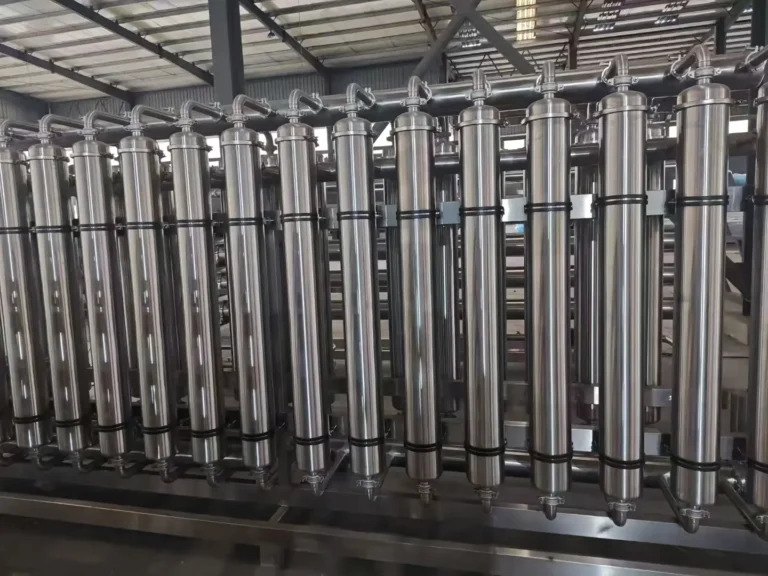
Solid-liquid separation is a fundamental process used to remove suspended solids, particles and other insoluble contaminants from liquids. It is widely applied in industrial water treatment, process filtration, wastewater treatment, chemical processing, food and beverage production, metalworking and many other industries.
The correct separation method depends on particle characteristics, required filtration accuracy, flow rate, solids concentration, liquid properties and downstream process requirements.
Among the available technologies, filter bag filtration and ultrafiltration (UF) are two practical solutions for industrial filtration. Bag filtration is commonly used for economical removal of suspended particles and as prefiltration, while UF membrane systems provide finer separation when higher filtrate quality is required.
Understanding the differences between these methods helps engineers and purchasing teams select a more suitable filtration solution for their operating conditions.
What Is Solid-Liquid Separation?
Solid-liquid separation refers to the removal of solid particles from a liquid phase.
The solids may include:
- Sand and sediment
- Rust and scale
- Process particles
- Suspended solids
- Metal particles
- Fibers
- Sludge particles
- Organic matter
- Colloidal contaminants
Depending on the application, the objective may be to recover a clean liquid, concentrate solids, protect downstream equipment or improve final product quality.
Industrial solid-liquid separation can use several technologies, including sedimentation, flotation, centrifugation and filtration.
For many industrial filtration systems, however, mechanical filtration and membrane filtration provide practical and continuous methods of controlling suspended contamination.
Bag Filtration for Solid-Liquid Separation
Bag filtration is one of the most common mechanical filtration methods used for removing suspended solids from industrial liquids.
A liquid filter bag is installed inside a filter housing. As contaminated liquid passes through the filter media, particles are retained while the filtered liquid continues downstream.
Bag filters are widely used because they offer relatively simple operation, convenient replacement and flexible filtration options.
Typical applications include:
- Industrial process water
- Cooling water
- Chemical liquids
- Paints and coatings
- Metalworking fluids
- Food and beverage processing
- Wastewater pretreatment
- Equipment protection
- General industrial liquid filtration
Advantages of Bag Filtration
Bag filtration can provide several practical advantages:
- Simple system design
- Relatively low replacement cost
- High dirt-holding capacity
- Easy filter bag replacement
- Multiple filter media options
- Different filtration ratings available
- Suitable for high-flow industrial applications
- Can be used as prefiltration before finer treatment processes
Filter bags can be manufactured from materials such as polypropylene, polyester, nylon and other filtration media depending on liquid compatibility and operating conditions.
The correct material should be selected according to temperature, chemical characteristics and filtration requirements.
When Is Bag Filtration Suitable?
Bag filtration is particularly useful when the main objective is to remove suspended particles before the liquid enters downstream equipment or a finer filtration stage.
For example, a filter bag may be installed before pumps, heat exchangers, membrane systems or other sensitive equipment to reduce the solids load.
Bag filtration can also be used independently when the required filtrate quality can be achieved using conventional filter media.
Before selecting a filter bag, consider:
- Required filtration rating
- Particle size
- Solids concentration
- Liquid viscosity
- Flow rate
- Operating pressure
- Operating temperature
- Chemical compatibility
- Required service life
Selecting only by bag size without evaluating these conditions may result in excessive pressure drop, short service life or insufficient filtration performance.
Ultrafiltration for Finer Solid-Liquid Separation
Ultrafiltration uses a membrane barrier to separate fine suspended solids, colloidal materials and other particles from a liquid.
Compared with conventional bag filtration, UF provides a much finer level of separation and is commonly used when consistent filtrate quality is required.
UF membrane systems are used in applications such as:
- Industrial water treatment
- Wastewater reuse
- Process water filtration
- Pretreatment before downstream purification
- Removal of suspended solids
- Reduction of turbidity
- Separation of fine particles and colloids
- Selected food and beverage processes
UF membranes may be supplied in different configurations depending on system design and application requirements.
Advantages of Ultrafiltration
UF membrane filtration can provide:
- Fine and consistent separation
- Effective suspended solids removal
- Reduction of turbidity
- Removal of fine particulate contaminants
- Stable filtrate quality
- Compact filtration systems
- Compatibility with automated operation
- Potential use as pretreatment for downstream processes
However, UF is generally more sensitive to feed-water conditions than simple bag filtration.
Excessive solids loading, unsuitable pretreatment or incorrect operating conditions can increase membrane fouling and cleaning frequency.
For this reason, pretreatment is an important part of many UF systems.
Bag Filtration vs. Ultrafiltration
Bag filtration and ultrafiltration are not necessarily competing technologies. In many industrial systems, they can be used together.
Solid-Liquid Separation Methods: When to Choose Bag Filtration
- The main contaminants are relatively larger suspended particles
- A simple and economical filtration stage is required
- Filter replacement needs to be quick and convenient
- The application is primarily equipment protection or prefiltration
- Extremely fine separation is not required
Choose Ultrafiltration When:
- Finer suspended solids or colloidal contaminants must be removed
- More consistent filtrate quality is required
- Turbidity reduction is important
- Conventional filtration cannot achieve the required separation
- The process requires a membrane-based separation stage
Use Bag Filtration Before UF When:
The incoming liquid contains a relatively high concentration of suspended solids or larger particles.
A properly selected prefilter can reduce the solids load reaching the membrane and help improve overall system stability.
The correct configuration depends on feed conditions and the required final water or process-liquid quality.
How to Choose Solid-Liquid Separation Methods for Industrial Filtration
There is no single filtration technology suitable for every process.
The following parameters should be reviewed before selecting equipment.
Particle Size
Larger particles can often be removed effectively using conventional mechanical filtration.
Finer suspended solids and colloidal contaminants may require membrane filtration.
Solids Concentration
Liquids containing high levels of solids can create rapid filter loading.
In these cases, filtration area, filter capacity and replacement frequency should be carefully evaluated.
Required Filtrate Quality
The required downstream quality is one of the most important selection criteria.
Equipment protection may require relatively simple filtration, while reuse or higher-purity processes may require much finer separation.
Flow Rate
Filtration equipment must be sized according to actual operating flow.
Insufficient filtration area can create excessive pressure drop and shorten service life.
Liquid Properties
Consider:
- Temperature
- pH
- Viscosity
- Chemical composition
- Oil content
- Corrosiveness
- Presence of solvents or other process chemicals
These conditions directly affect the selection of filter media, membrane materials and sealing components.
Operating Pressure
The filter housing, filter element, filter bag or membrane module must be suitable for the actual pressure conditions of the system.
Typical Industrial Applications
Solid-liquid separation technologies are used in many industrial processes.
Industrial Water Treatment
Filtration removes suspended solids from incoming water and helps protect downstream equipment.
Depending on the required water quality, bag filtration may be used alone or as pretreatment before membrane filtration.
Wastewater Treatment
Industrial wastewater can contain suspended solids, process residues and fine particles.
Solid-liquid separation can reduce particulate contamination before discharge, reuse or additional treatment.
Chemical Processing
Chemical manufacturing often requires filtration of process liquids, raw materials or finished products.
Filter media must be selected carefully because chemical compatibility can be as important as filtration accuracy.
Metalworking and Manufacturing
Machining fluids, process water and industrial liquids may contain metal particles, scale and other contaminants.
Filtration helps protect pumps, nozzles and process equipment while supporting more stable production.
Food and Beverage Processing
Solid-liquid separation may be used for process-water filtration, clarification, ingredient filtration and other production stages.
Food-contact requirements, sanitation and material compatibility should be considered during equipment selection.
How to Specify a Liquid Filter Bag
For replacement or custom liquid filter bags, provide:
- Bag diameter
- Bag length
- Required filtration rating
- Filter media
- Ring or top construction
- Operating temperature
- Operating pressure
- Liquid type
- Flow rate
- Solids characteristics
- Required quantity
If an existing filter bag is being replaced, a sample, drawing or current specification can help confirm compatibility.
How to Specify a UF Membrane
For UF membrane selection, provide as much operating information as possible, including:
- Feed liquid type
- Required flow capacity
- Feed-water quality
- Suspended solids level
- Required filtrate quality
- Operating temperature
- Operating pressure
- Existing membrane model, if applicable
- Module dimensions
- Connection requirements
- Cleaning conditions
For replacement projects, the existing membrane manufacturer and model are particularly useful for evaluating dimensional and hydraulic compatibility.
Building a Practical Solid-Liquid Separation System
A well-designed filtration process often uses more than one separation stage.
A typical arrangement may include:
Coarse filtration → Bag filtration → UF membrane filtration → downstream process
The exact sequence depends on the contamination level and final filtration objective.
Using a suitable pretreatment stage can reduce the load on finer filtration equipment and help improve operating stability.
Rather than selecting individual filters independently, the complete filtration process should be evaluated as a system.
Information to Provide When Requesting a Filtration Quotation
For faster technical evaluation, purchasing teams should provide:
Process Information
- Liquid being filtered
- Flow rate
- Operating pressure
- Operating temperature
- Solids concentration
- Particle characteristics
Filtration Requirements
- Required filtration accuracy
- Required filtrate quality
- Current filtration method
- Existing filter model or specification
Equipment Information
- Existing housing or membrane module dimensions
- Connection sizes
- Drawings or photographs
- Current filter or membrane sample, if available
Providing complete operating information helps avoid incorrect filter selection and reduces the risk of compatibility problems.
Conclusion
Solid-liquid separation is an important part of industrial filtration, but the correct technology depends on the actual process requirements.
Bag filtration provides a practical and economical solution for suspended solids removal, equipment protection and prefiltration, while ultrafiltration provides finer separation when higher filtrate quality is required.
In many industrial systems, the best solution is not choosing one technology instead of another, but combining filtration stages according to particle size, solids concentration, flow rate and required final quality.
For replacement or custom filtration projects, providing operating conditions, dimensions, existing specifications or samples allows the filtration solution to be matched more accurately to the application.